On-device RAG: answers from your own documents
How local retrieval connects personal documents to AI answers, with source references and a knowledge index that stays on the device.
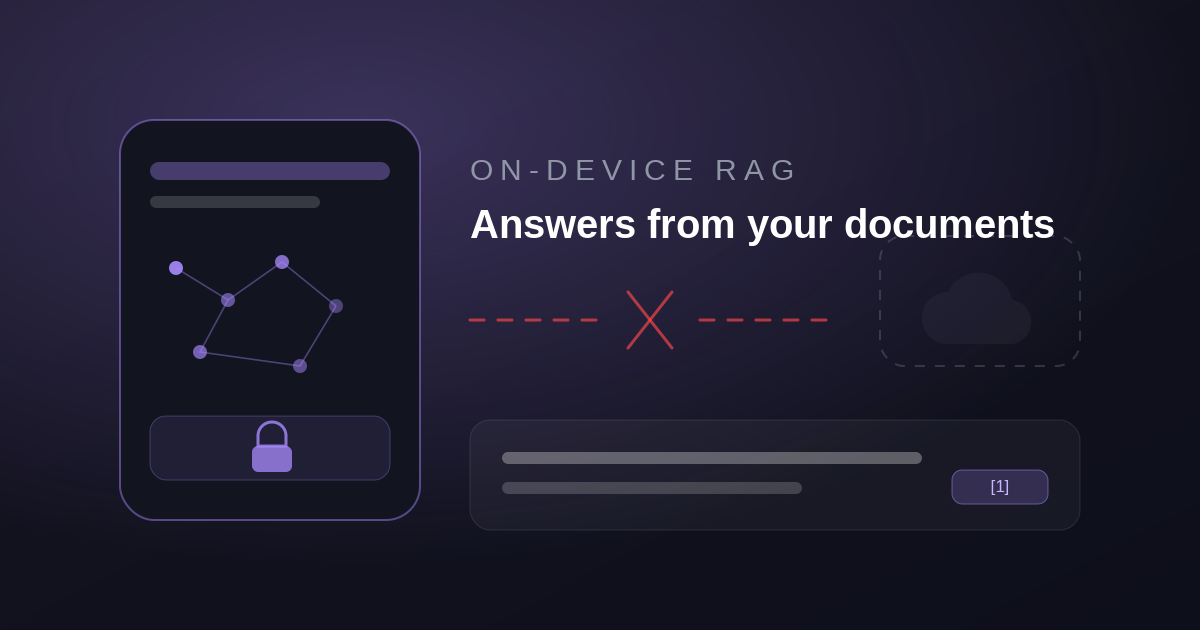
A useful answer often depends on information a general AI model has never seen: a project brief, meeting notes or a document saved on your phone. Finding that information should take less effort than reading every file again.
Retrieval-augmented generation, or RAG, connects a question to relevant passages before a model writes its answer. Running that process locally gives personal knowledge a clear home: the device that holds it. This is the architecture behind our work on Private Brain for DigitMind AI.
Find the right passage before writing the answer
The system first turns imported documents into a searchable collection of short passages. Each passage receives an embedding: a numerical representation that helps match its meaning to a question.
- Prepare the documents and divide their text into passages with source references.
- Build a local index of those passages.
- Use the question to retrieve relevant context from the index.
- Give that context to a local model, then return an answer with links to the sources.
This keeps the context focused. A question about one decision can draw on the relevant section of a document without sending the entire collection to the model.
Keep personal knowledge on the device
The model files are downloaded during setup. In the local pipeline, document processing, retrieval and answer generation run on the phone. Private content can be used without uploading the document collection to a remote inference service.
The saved index is encrypted and scoped to the knowledge vault it belongs to. It is derived from the documents: when a source changes or is removed, the index must be refreshed so future answers use the current collection.
Make the answer easy to inspect
A source reference is part of the reading experience. It should open the passage behind an answer so the reader can check its wording, context and relevance. For a question such as “What did we agree about the rollout?”, that route back to the original note is as useful as the summary itself.
Retrieval also needs a clear outcome when the collection contains no relevant material. The answer should make that gap visible, giving the reader a reason to add a source or refine the question.
Work within the phone’s resources
Indexing and generation have different memory needs. Preparing the index separately lets it be reused across questions. Loading the required model for each stage and releasing it afterwards leaves more memory for the rest of the app.
Model size, available memory and the amount of retrieved context shape response time. Those constraints influence the experience: how much information can be processed at once, when progress needs to be shown and how the user stops a request.
An extension of personal memory
On-device RAG is useful when the answer lives in material the user already owns. It can help recover the reasoning behind a decision, find a detail buried in notes or bring related passages together. The value comes from shortening the distance between a question and the source that can answer it.